The
Filkins-Broadwell Tornado
Click
all photographs for larger copies
Moving eastwards from Broadwell, the tornado would now have encountered more open agricultural land. However, mixed with this land-use were small areas of trees, or copses. Once again, hedgerows were often lined with large trees, and in this area some very large trees indeed with destroyed. The next aerial image has been zoomed out once again, to take account of much of the damage across this open land. Numbers 13-15 denote the damage to buildings in Broadwell, as examined earlier, with the damage swathe moving eastwards.
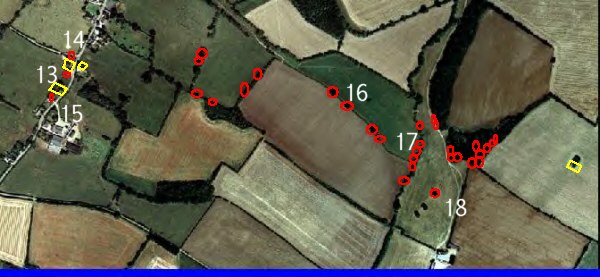
Open
farmland and copses east of Broadwell.
Image from www.getmapping.com
Leaving Broadwell and heading eastwards through the fields, a clear path of damage is evident through trees lining the field boundaries. Many of the trees, such as this one below, were very large indeed and in fairly good health. This particular one had been snapped through the main trunk, just above ground level.
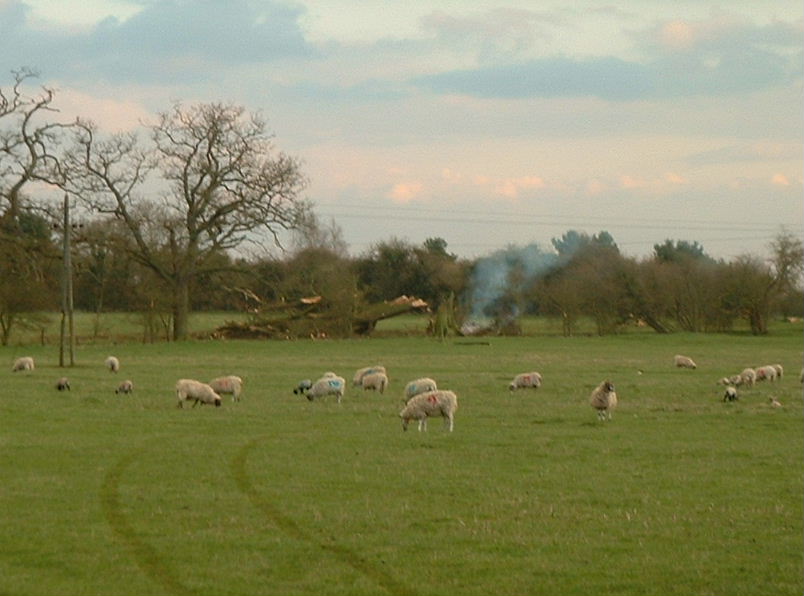
(16)
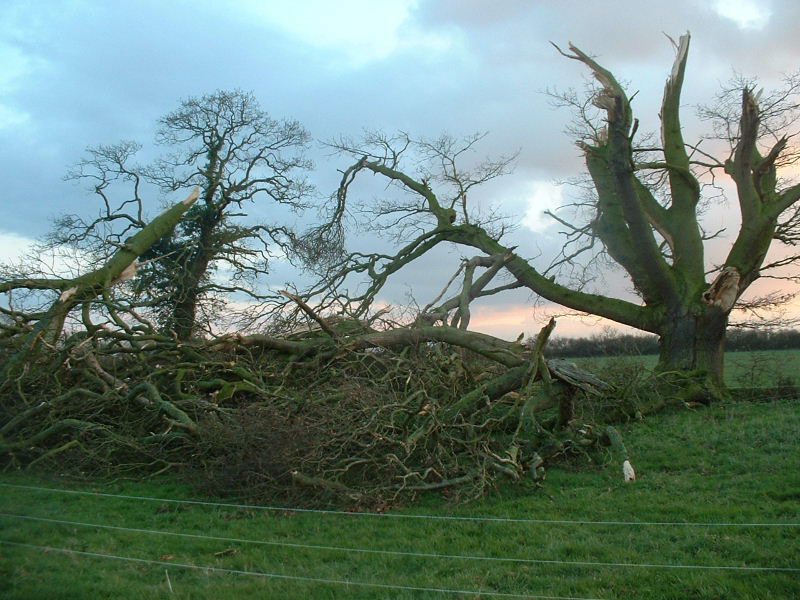
Continuing through the meadows, one line of trees running west-to-east took the full force of the tornado. The trees are aligned parallel to the direction of travel of the vortex, and thus were systematically damaged as it passed over. Most of these trees were of considerable size, and again in mostly good health. Some of the trees were stripped to the trunk, whilst others had major bows and limbs sheared off. The first image below shows the line of trees, with damage extending from the foreground into the distance. The final image in this set of three shows just how far a large branch has been carried from its parent tree, before being released.
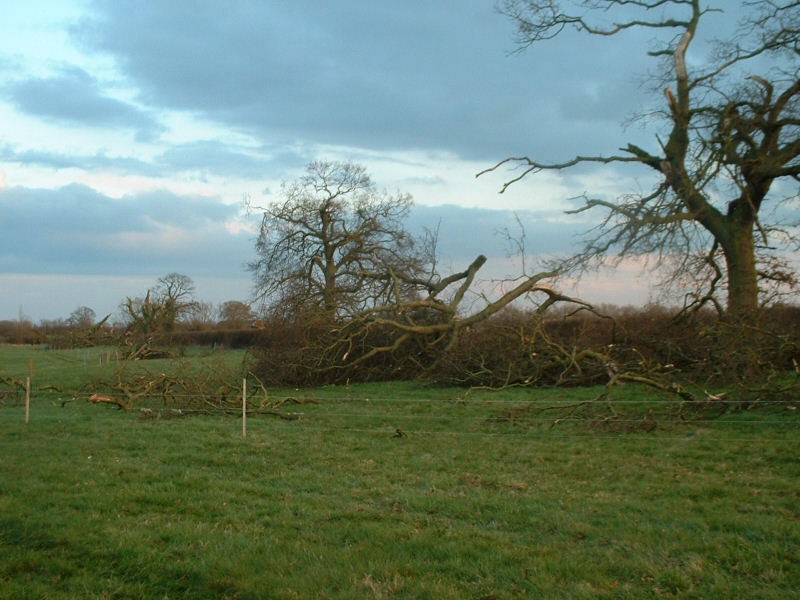
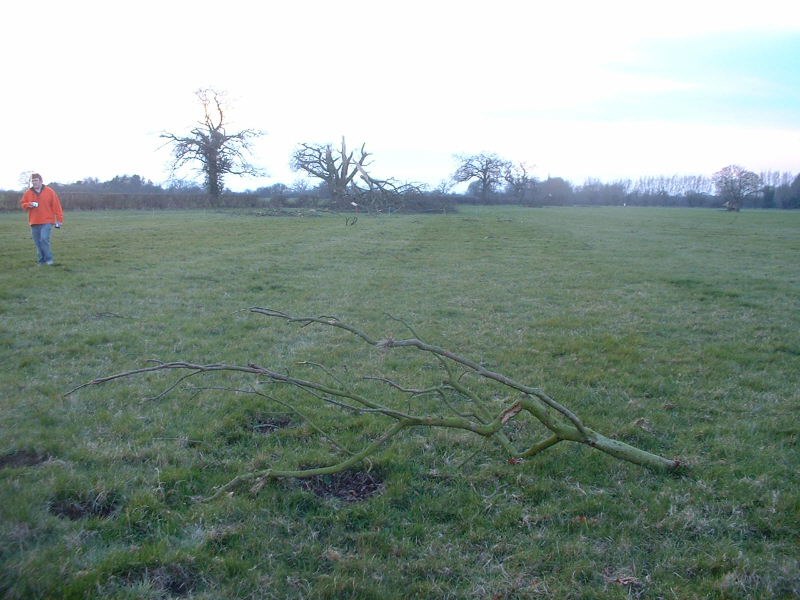
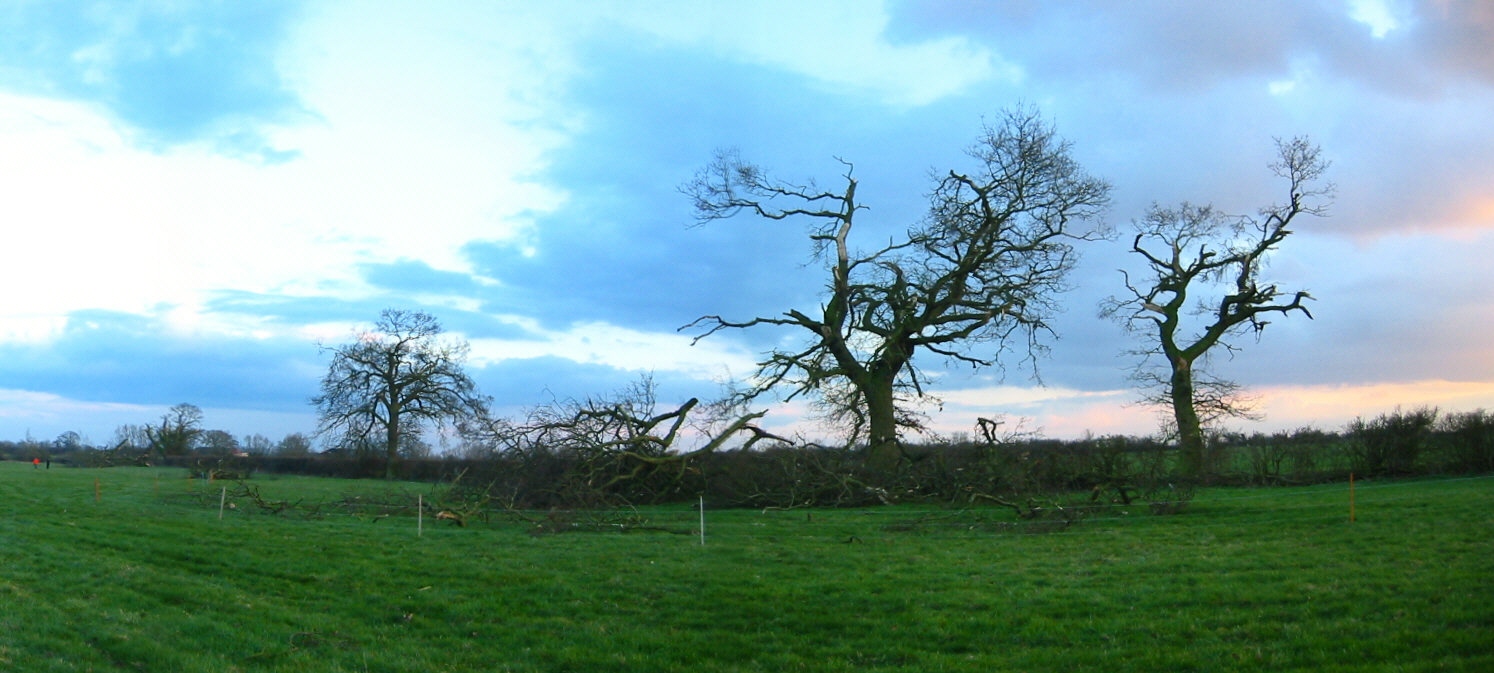
Here is a larger iamge of the line of trees damaged by the tornado - the downed
branches and trees continue into the distance past where I was walking on
the left of this image.
(17)
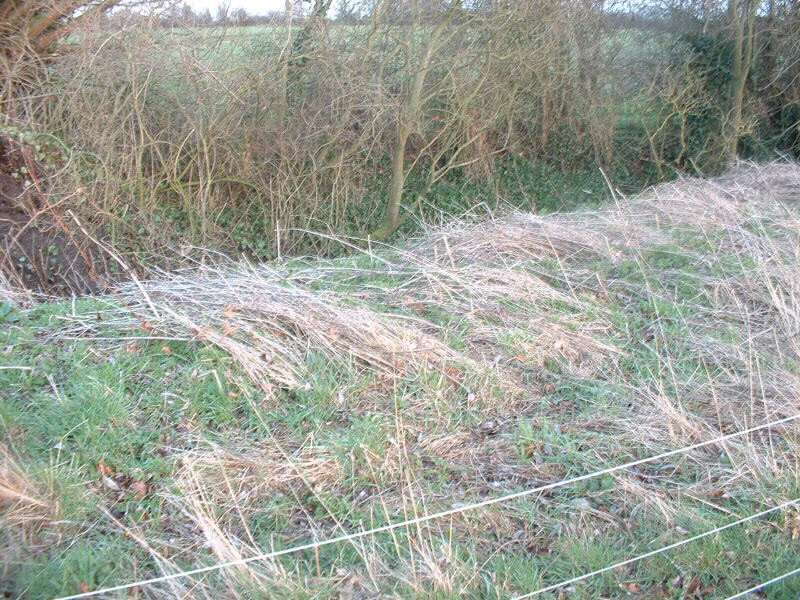
At the eastern edge of the field, long grass had been flattened in a uniform direction, indicating that the southern side of the tornado, comprising the most powerful westerly wind component, had passed over them.
(18)
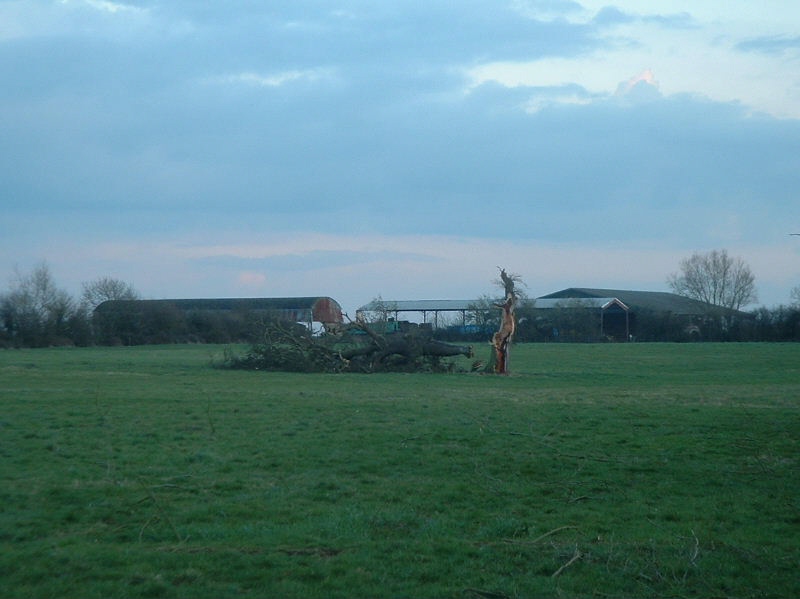
Beyond this, we could see a distant tree which would have taken the full force of the southern edge of the tornado. This was a very large, if slightly rotten tree, which was nonetheless snapped in two with great ease.
We didn't travel any further eastwards on foot, and returned to our car which was left in Broadwell. Next we headed for the village of Alvescot, north-east of Broadwell, from where we could gain access to a bridleway. Assuming the tornado track continued, the theory was that if we followed this bridleway southwards, then we wouldd intercept the track of the tornado once again. The theory ran like clockwork!
(19)
From the bridleway, we could see back westwards to the copse of trees we had previously only seen from its west. A clear "chunk" had been taken out of the trees, as can be seen in the following image. As well as this, the barn in the centre-left of the image had much of the southern side of the roof missing, possibly more than a coincidence given it was in the centre of the tornado's path.
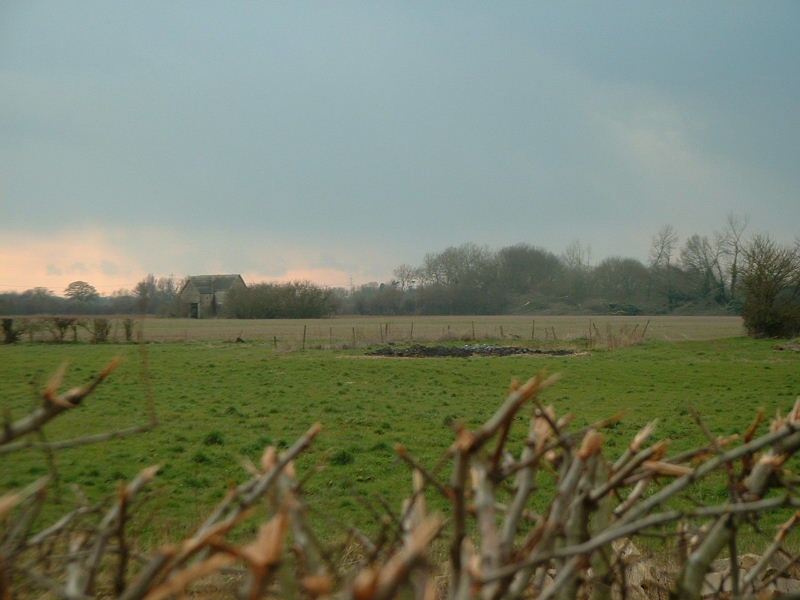
(20)
The bridleway we followed southwards eventually ran through a corridor of small trees, and this was where we expected any damage to be. Sure enough, there was a distinct 150-200 yard (135-180m) swipe taken out of the trees, with little or no damage outside of this zone. The following images show this damage, although by this point the intensity of the damage had reduced, possibly indicating a decaying vortex.
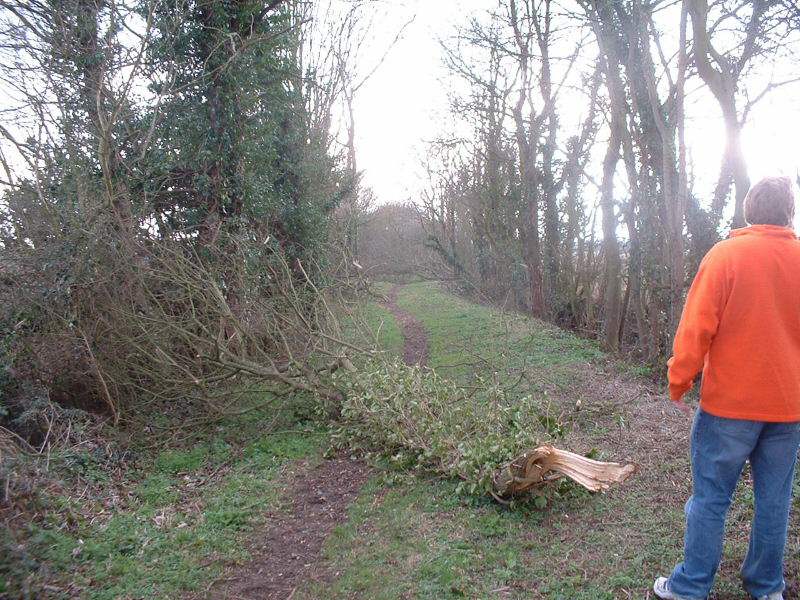
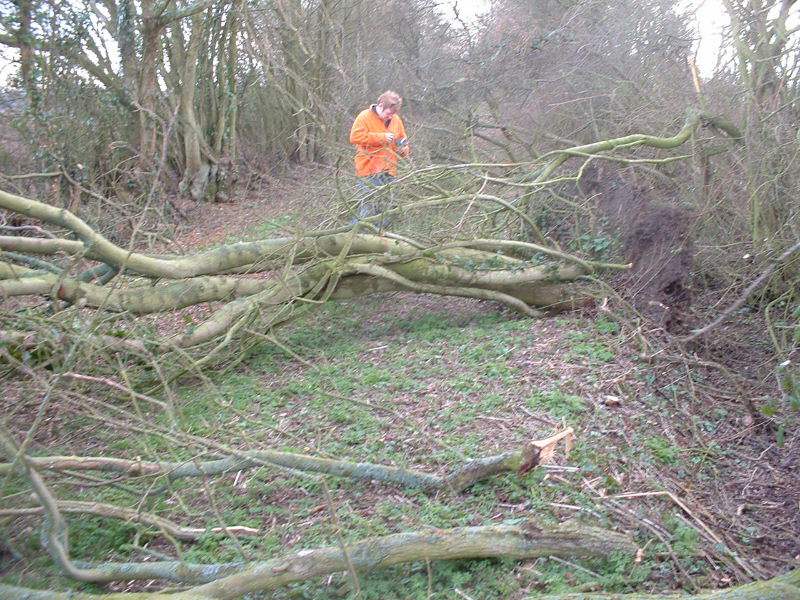
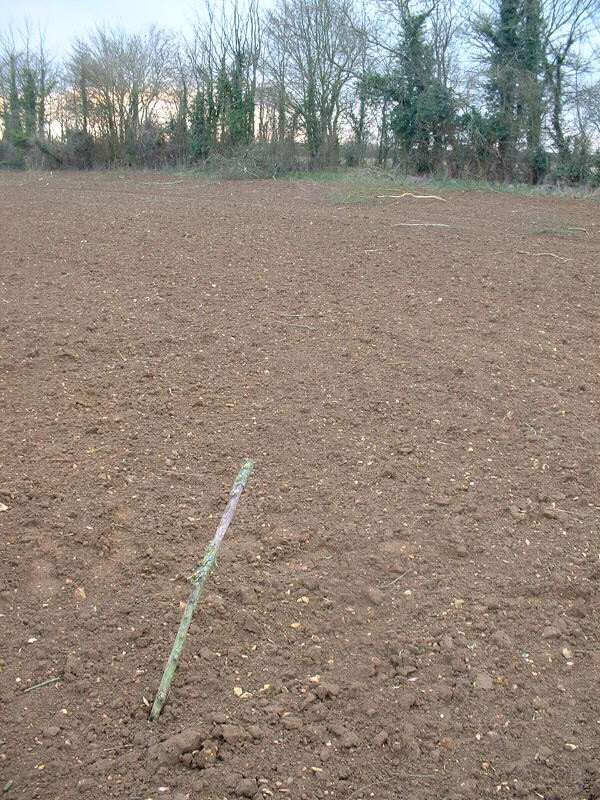
Looking further eastwards along the imaginary path of damage, there appeared to be more branches felled at the far side of the field, and in the distance a very large tree appeared to have minor damage, with evidence of freshly snapped branches. However, it became clear that, at this point at least, the tornado had weakened and had perhaps lifted off the ground soon after it had passed this location.
With fading light, we therefore decided to end our tornado investigation on the ground, and returned home to analyse a possible damage path, as evidence that this was a tornado, and not just straightline downdraft winds. The results were conclusive.